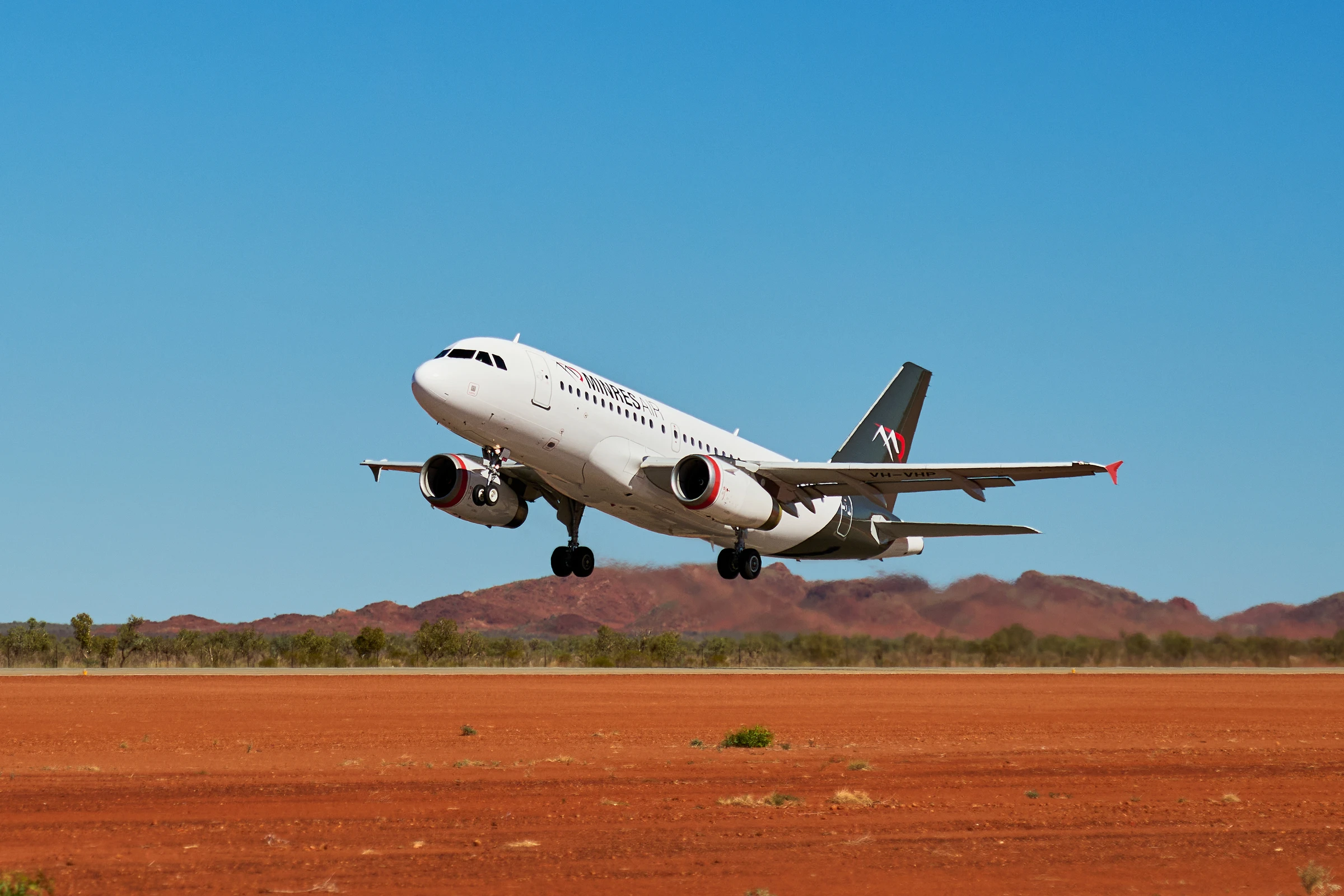
Built entirely in-house, MinRes Air has a clear mandate: to transport the MinRes workforce to and from site as efficiently and comfortably as possible. This is part of a broader company commitment to setting new industry standards across flights, facilities and food.
Two years and 2,000 flights later, a fleet of four aircraft now connects MinRes' FIFO workforce to every one of the company's operational mine sites across Western Australia, transporting between 8,500 and 9,500 passengers each month.
A first for the resources industry
While most mining companies depend on commercial airlines or third-party charter operators to move their workforces, MinRes took a fundamentally different approach by bringing its aviation capability entirely in-house.
This extends to the MinRes Air workforce, as MinRes Air CEO Graeme Taylor explains.
“Every member of the MinRes Air team, from pilots and cabin crew to engineers and ground staff, is directly employed by MinRes, drawing on experience accumulated across Australia and internationally,” Taylor said.
“This structure shapes the culture and consistency of the MinRes Air operation at every level, ensuring that the standards applied on the ground are reflected in the service delivered in the air.”
Performance that delivers
On-time performance is an important metric in FIFO aviation, with direct implications for site productivity, workforce rostering and employee welfare.
Taylor said this was an area where MinRes Air has established a clear and measurable advantage.
“Our planes arrive on time or ahead of schedule approximately 97–98% of the time, a figure that sits 15 to 20 percentage points above the industry average,” he said.
“For a FIFO workforce, that level of reliability has meaningful flow-on effects and reduces unplanned downtime at site, supports roster precision and ensures employees maximise time at home between swings.
"We pride ourselves on our on-time performance as we are very much a service-driven, people-focused business."
Operational efficiency extends beyond the flight itself. After a swing, passengers exit the terminal within 10 to 15 minutes, ensuring they can return home to their families as quickly as possible.
An experience above industry standard
Manager Cabin Crew Renae Isaacs said the service was more personalised than the one-size-fits-all model offered by charter airlines.
"Our cabin crew get to know our passengers very well - we understand that many are beginning or ending a long swing, so our focus is on making the onboard experience smooth, seamless and as comfortable as possible," she said.
The experience is designed to begin well before boarding. The dedicated MinRes Air terminal has been purpose-built to streamline the pre-flight experience for FIFO travellers.
Terminal amenities include complimentary Wi-Fi, charging stations and a selection of complimentary refreshments and barista-made coffee, establishing a consistent and considered standard of service from the moment passengers arrive.
That same commitment to quality continues onboard. MinRes Air's A319 and A320 aircraft are configured with 150 seats which is substantially fewer than the 180-seat layouts commonly deployed by commercial operators in equivalent aircraft.
This delivers up to 25 centimetres of additional legroom relative to industry standard, providing a materially more comfortable travel experience.
Beyond passenger transport
While the safe and efficient movement of people remains the primary function of MinRes Air, the airline has expanded its operational scope since launch.
"Since we began flying, we've moved into operational freight, transporting critical parts to site, as well as cyclone recovery and shutdowns," said Taylor.
“This demonstrates how agile our airline is.”
This expanded capability positions MinRes Air as more than a transport function. It is a valuable operational asset that contributes directly to the resilience and continuity of MinRes's mining operations.